Simone de Beauvoir informs us of the problems with Othering that happens in sex and gender. Too often women are secondary to men in language and in acts, and men are seen as the original, the independent, the normal. In the video below we see a slight switch in the way this is handled specifically when concerned with the role of breadwinner and parent.
So the issue here is that the man is insulted at now being the "wife". He does not bring home the money and he takes care of the kids, so he's not secondary to his actual wife. I would say this would be an interesting way in making men feel secondary, however the fact that the title "wife" is still being used is more or less insulting to women. If one were to take this aspect out, however, and maybe discuss experimenting with the use of Woman and Husband as opposed to Man and Wife, then that would be interesting. So since this commercial doesn't do that (although to be fair, could it? that might be confusing in such a small amount of time) I'm more or less inclined to think that the message behind it is that the role of a woman, given to a man, is emasculating and embarrassing. This is unfortunate, because the language used here is just as bad as anything else that keeps us all in this frame of Man as the original and correct and Woman as the Other, the secondary, the wrong. It pulls away from the attempt to just see men and women as two sides of the same coin, it does not allow for mixing of gender roles even though the comfortable initially seemed comfortable with his choice. Those defending commercials like these could argue that Yiayia is merely traditional because of her age, and so it's funny that she's so traditional, but it doesn't look that way to me considering the wife does not argue the point Yiayia makes, and the children laugh. The husband himself looks almost ashamed. It's all portrayed as though that were the appropriate way for him to react considering he's lowered himself to such a position. So what we see is a shaming of the attempt on Man's part to take some roles from the Other. Another way to separate the two so that they're always seen not as opposites, but as superior and inferior, oppressor and oppressed.
Works Cited
"Yiayia on Parenting" 25 February 2011. YouTube. 03 May 2011.
http://www.youtube.com/watch?v=x9LinzE_85I&feature=player_embedded
Tuesday, May 3, 2011

Tuesday, April 26, 2011
Analysis 5: Discipline and Punishment
The video above illustrates the way that fashion works as a way for us to keep each other in line by monitoring each other and internalizing what is right and wrong. Fashion is something more than just what you're wearing depending on the temperature outside. Fit matters, color matters, trends matter, material matters, and so on. Clothes don't often exist for the mere practicality of keeping yourself from being nude, they exist to express personality but also to establish status and opinions. A guy choosing to wear loose fitting, cheap clothes is no more rebellious than the man wearing an expensive suit, because both styles are statements, both were chosen with something in mind, both send out a message that others will receive and decode.
We use fashion to judge each other all the time, and though many think they are rebelling, no one ever truly rebels unless they chose to go naked altogether, and even then I'm not sure. As I said, we all judge: the girl with the jeans and loose fitting shirt is too lazy to care about her appearance, the guy with the baggy jeans and oversized shirt thinks he's a baller or a player or something or another, the girl with the short skirt and the top that might as well be a bra has no self-esteem so she dresses in such a way for attention, the man who dresses in tailored pants and jacket is stuck up and privileged and therefore not likable. We do all these things, along with their positive flip sides to keep each other in line. We do it so much that it now appears in television all the time with titles such as "Fashion Do's and Dont's" to remind us of all the minor details of what's appropriate when and where. It is another way to easily check if anyone in society is stepping out of line, because all it requires is a quick glance in that person's direction.
Works Cited
"Fashion Dos & Don'ts" 22 August 2007. YouTube. 26 April 2011.
http://www.youtube.com/watch?v=uV6xl5VHTHc
Wednesday, April 13, 2011
The Panopticon and Feminist Theory
While recently learning of the concept of Jeremy Bentham's Panopticon and Foucoult's take on how this works for the general society I couldn't help but make connections to how women are treated in our society specifically. The idea is that in a prison shaped like a circle with prisons along the border and a guard in the middle we eventually develop a greater sense of being watched and thus are likely to behave better. We also would develop a habit of regulating each other and making sure no one gets out of line. We do that in our society as well, by criticizing the choice of cars others own or the choice of garden decorations displayed in front of a neighbor's home. One would argue that this supervision of each other is great because it's like a large community watch to keep anyone from committing crimes, and it keeps us all moral.
But doesn't it also work to oppress us? Specifically, doesn't it work to oppress women? (It works to oppress many other groups as well, but women's issues is the area I've put the most thought in.) Don't we have a problem in which we regulate the way we all think of women by judging their appearances, making sure they're aware of what we think of their various actions such as the kind of sex life they lead or the way they dress? At this point, we're monitoring the behavior of another person in such a way that we are not keeping them from committing crimes, but rather we are limiting their freedom by making them feel as though they could be outcasted if they did not become submissive quickly and readily enough. A woman might not date a certain person because of what her friends and family will think of her. A woman might not wear certain kinds of clothes because she's afraid she'll be branded a whore. A women will be afraid to voice opinions in an assertive way because others will likely brand her a loud-mouthed b-word. I believe there simply comes a point where society monitors itself far too closely so that it becomes unhealthy. It is a neighbor's business if the person next door is fighting roosters illegally, but it is not their business if a single woman has a man over at two in the morning. It's unhealthy to monitor each other in such a way that we all end up feeling like we have to follow rigid rules in order to be accepted.
But doesn't it also work to oppress us? Specifically, doesn't it work to oppress women? (It works to oppress many other groups as well, but women's issues is the area I've put the most thought in.) Don't we have a problem in which we regulate the way we all think of women by judging their appearances, making sure they're aware of what we think of their various actions such as the kind of sex life they lead or the way they dress? At this point, we're monitoring the behavior of another person in such a way that we are not keeping them from committing crimes, but rather we are limiting their freedom by making them feel as though they could be outcasted if they did not become submissive quickly and readily enough. A woman might not date a certain person because of what her friends and family will think of her. A woman might not wear certain kinds of clothes because she's afraid she'll be branded a whore. A women will be afraid to voice opinions in an assertive way because others will likely brand her a loud-mouthed b-word. I believe there simply comes a point where society monitors itself far too closely so that it becomes unhealthy. It is a neighbor's business if the person next door is fighting roosters illegally, but it is not their business if a single woman has a man over at two in the morning. It's unhealthy to monitor each other in such a way that we all end up feeling like we have to follow rigid rules in order to be accepted.
Tuesday, March 29, 2011
Analysis 4: Marxist Theory
So Marxist theory deals with the value of labor and many criticisms against capitalism. I've always found it interesting to consider the kind of people that would despise Marxist theory and the kind of people that would embrace it. It's more likely than not that the poor people of a capitalist society will embrace it, considering they stand to gain something and hardly lose anything. In my current position in life (specifically financially) I think I stand somewhere in the middle when concerning what I have to gain and what I have to lose. I'd much rather look at the extreme in this case, particularly the poor, because in the United States we have such a problem with only every considering the rich.
The concerns of the rich are the concerns of all, but the benefits and consequences of the behavior of the rich aren't evenly spread. Considering the recent economic crisis, it can be argued that the rich benefited from their behavior while the poor reaped the consequences. It specifically makes me think back to a book I read, Germinal, by Emile Zola.
The story within this book deals with the lives of the poor working class that live in the area of the mines, toiling away underground in order to at least put food on the table for their family, while the rich become even richer off of all the poor people's work. Marxism comes into play here with the character of Etienne, who believes that the middle class need to be removed so that the working class can have their fair share and would no longer have to suffer the way they do. With the character of Etienne, Marxism comes off as almost being too ideal, like some kind of utopia that can be easily achieved if one only sets their mind to it. I think this is more or less the fault of the character for being naive in the way he sees things.
I think that Marxism wouldn't really work regardless, though. You see throughout the book that even characters of the poor working class constantly strive to step on their comrades necks in order to get ahead, and I genuinely think it's a reflection of human behavior in the real world. You'd need a considerable amount of laws to keep everyone even and make sure that no one thought about finding a way to get ahead of their fellow people. I know many would argue against this, but I do believe it's slightly part of human nature to be competitive. I should explain that I think in a much smaller group, a set of people could work quite fantastically together to create a little village (or what have you) into something that resembles Marxism, but considering how large the world is, and how it's getting bigger by the second, I don't think something like that can be maintained on such a scale. In the larger scale, in other words, systems like Marxism just don't work. It's a shame, but I see the example of this in the way the United States is currently run. If we were incredibly smaller, then I'd believe much more strongly in the ideals of capitalism.
Works Cited
Zola, Emile. Germinal. England: Penguin Books Ltd. 1885
The concerns of the rich are the concerns of all, but the benefits and consequences of the behavior of the rich aren't evenly spread. Considering the recent economic crisis, it can be argued that the rich benefited from their behavior while the poor reaped the consequences. It specifically makes me think back to a book I read, Germinal, by Emile Zola.
The story within this book deals with the lives of the poor working class that live in the area of the mines, toiling away underground in order to at least put food on the table for their family, while the rich become even richer off of all the poor people's work. Marxism comes into play here with the character of Etienne, who believes that the middle class need to be removed so that the working class can have their fair share and would no longer have to suffer the way they do. With the character of Etienne, Marxism comes off as almost being too ideal, like some kind of utopia that can be easily achieved if one only sets their mind to it. I think this is more or less the fault of the character for being naive in the way he sees things.
At the centre was still the idea put forward by Karl Marx: capital was the result of theft, and labour had the duty and the right to recover this stolen wealth. As to putting this into practice, Etienne had at first been seduced, like Proudhon, by the attractions of mutual credit, if one vast clearing bank that would cut out all the middlemen; then it hand been Lassalle's idea of co-operative societies, funded by the State, which would gradually transform the earth into one great big industrial city, and he had been widly in favour of this until the day he was finally put off by the problem of controls; and recently he had been coming round to collectivism, which called for the means of production to be returned into the ownership of the collective. But this was all still somewhat vague, and he couldn't quite see how to achieve this new goal, prevented as he was by scruples of humanity and common sense from enjouing the fanatic's ability to advance ideas with uncompromising convition. For the moment his line was simply that what they had to do first was to take power. Afterwards they'd see. (242)
I think that Marxism wouldn't really work regardless, though. You see throughout the book that even characters of the poor working class constantly strive to step on their comrades necks in order to get ahead, and I genuinely think it's a reflection of human behavior in the real world. You'd need a considerable amount of laws to keep everyone even and make sure that no one thought about finding a way to get ahead of their fellow people. I know many would argue against this, but I do believe it's slightly part of human nature to be competitive. I should explain that I think in a much smaller group, a set of people could work quite fantastically together to create a little village (or what have you) into something that resembles Marxism, but considering how large the world is, and how it's getting bigger by the second, I don't think something like that can be maintained on such a scale. In the larger scale, in other words, systems like Marxism just don't work. It's a shame, but I see the example of this in the way the United States is currently run. If we were incredibly smaller, then I'd believe much more strongly in the ideals of capitalism.
Works Cited
Zola, Emile. Germinal. England: Penguin Books Ltd. 1885
Wednesday, March 23, 2011
Marxism is so damn depressing.
That's right, Marxism is depressing. I have to admit first off that I personally don't know every single detail or variation of Marxism theory for several reasons but the one reason that specifically comes to mind more often is the simple fact that Marxist theory depresses me. It completely depresses the heck out of me because of the focus on the value of labor and production. My understanding is that too much value on the human being is placed on simply what product they can create, how fast they can do it, and how cheap they can be paid. I think of coal mines and I think of poverty for the working class, so yes, a bit depresssing.
This is of course not to say that I think the theory is wrong, in fact I think it's a little too accurate, which is why it depresses me. I dislike a world in which I am only worth the amount of pizzas I make and how quickly I can make them (I work with food in general). I guess I shouldn't say it's accurate, though. We in the United States are allowed to work towards showing our worth in producing something we genuinely enjoy producing. Authors have been made rich, so have film makers, and so have musicians. They aren't all working in a factory repeatedly making one small piece of a larger object day in and day out.
Unfortunately, we can't all be authors and musicians can we? I'm still working in food even though I'd rather be working with animals. At the moment though, that kind of production isn't found to be very valuable so it's not really an option. When capitalism is at its worst we really lose the beauty of being able to get rich out of doing something you love rather than someone that will benefit the majority as soon as possible. It will benefit the majority for me to work in making pizzas and sandwiches and so on, it won't really help them, at least not immediately, for me to work in animal rescue or what have you.
I don't believe that some of the solutions brought forward by Marxism are very ideal. Actually, the problem is that they're too ideal. In the end, our current system seems to work for the best, it's just got a lot of problems concerning priorities.
This is of course not to say that I think the theory is wrong, in fact I think it's a little too accurate, which is why it depresses me. I dislike a world in which I am only worth the amount of pizzas I make and how quickly I can make them (I work with food in general). I guess I shouldn't say it's accurate, though. We in the United States are allowed to work towards showing our worth in producing something we genuinely enjoy producing. Authors have been made rich, so have film makers, and so have musicians. They aren't all working in a factory repeatedly making one small piece of a larger object day in and day out.
Unfortunately, we can't all be authors and musicians can we? I'm still working in food even though I'd rather be working with animals. At the moment though, that kind of production isn't found to be very valuable so it's not really an option. When capitalism is at its worst we really lose the beauty of being able to get rich out of doing something you love rather than someone that will benefit the majority as soon as possible. It will benefit the majority for me to work in making pizzas and sandwiches and so on, it won't really help them, at least not immediately, for me to work in animal rescue or what have you.
I don't believe that some of the solutions brought forward by Marxism are very ideal. Actually, the problem is that they're too ideal. In the end, our current system seems to work for the best, it's just got a lot of problems concerning priorities.
Tuesday, March 22, 2011
Analysis 3: Psychoanalysis and the Oedipus Complex
The above video is, I think, a great example of a well known film that uses a bit of the ol' Oedipus complex described in Freud's "The Interpretation of Dreams". Marty McFly gets transported in a time machine to the past where he meets his mother and his father before they've been begun dating. The problem is that Marty takes the place of his father at a crucial point in which George (his father) and Lorraine (his mother) meet. So instead Marty and Lorraine meet and Lorraine instantly becomes smitten with him. Marty is so very obviously uncomfortable with this, however he doesn't realize how serious the problem is until it becomes obvious that his mother is no longer going to fall for his father and is even at risk of being taken by another guy entirely. Marty is uncomfortable at the idea of taking his father's place but is also completely against the idea of anyone else doing so. Certainly the difference here is that in since this deals with time travel Marty and his siblings would be erased from existence, but I think overall this is an interesting take, possibly not a conscious one, on Freud's theory. What does it mean that Marty is completely disgusted with being physical with his mother? Does he experience guilt in thinking she's pretty, as he mentions at one point in the film? What does it mean that at some point Lorraine too recognizes that something's off? Is it a way to show that relatives share an unseen connection that goes beyond blood and DNA that all of us can sense even through space and time? Or is it simply a way to ease Marty's guilt at wanting his mom? I won't say that Freud was right in his theory that people feel this rivalry with their fathers regarding their mothers, but I do think that people find it to be an interesting scenario to be stuck in. I think many of us want to shun times in which relatives married each other by showing how modern day people would reject such an idea on all levels. It's interesting to consider, all in all.
Works Cited
"Marty McFly in Lorraines house" 31 July 2007. YouTube. 22 March 2011. http://www.youtube.com/watch?v=2YVxzBR7xMo&feature=player_embedded
Wednesday, March 2, 2011
Analysis 2: The Word Picture
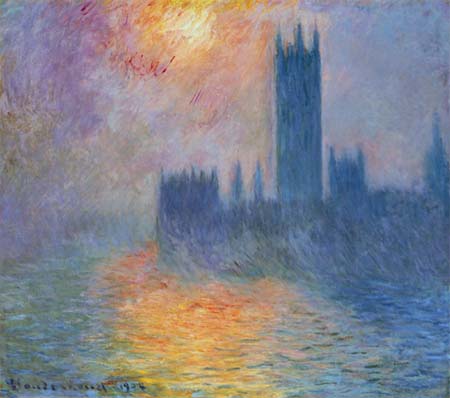
In this painting, The Houses of Parliament by Claude Monet, we see the silhouettes of the houses of Parliament with almost entirely blurred lines and no sharp images. The setting is sunset and the two things that stand out the most is the tallest tower of Parliament and the sun. There are no color blocks, all colors blend in with each other and it is not easy to pick out any particular detail. The colors involve mostly blues, some oranges with some red and variations on those colors due to them blending out into one of the other colors. It simply shows us a blurred image of the houses of Parliament at sunset.
I believe it would be interesting to analyze this painting from a Formalist perspective, considering we could look at the minimum of what Monet offers to us here. The way he paints, you often want to look beyond what is simply painted to what the image symbolizes, but in using Formalism we'd have to think simply about what is there not what we think is intended in inspiration. So the focus here is the silhouette of Parliament and the sun along with a bluish background. I suppose we can focus on the choice of lighting, since art all tends to have lighting coming from somewhere, even if the source is not easily identifiable. The source of light is the sun here, and it is the only source of light almost directly above the center of the image. Monet has chosen to contrast his colors and he has chosen to blend them and make them complimentary. Artists often choose one or the other. He chose landscape rather than portrait, since that allows him to focus less on detail and more on the broader picture. Because of this and because he chose to blur the entire thing I think we're allowed to focus the three points I mentioned earlier only: the sun, Parliament, and the blue background. To me this says that this is all Monet wanted you to see, rather than for you to see the tiny details of the windows of the lines of the ground and so on.
Works Cited
McCrory, Jeremiah. "Claude Monet Prints on Demand"Art of Europe Web. 2 March 2011 http://www.artofeurope.com/
Subscribe to:
Posts (Atom)