That's right, Marxism is depressing. I have to admit first off that I personally don't know every single detail or variation of Marxism theory for several reasons but the one reason that specifically comes to mind more often is the simple fact that Marxist theory depresses me. It completely depresses the heck out of me because of the focus on the value of labor and production. My understanding is that too much value on the human being is placed on simply what product they can create, how fast they can do it, and how cheap they can be paid. I think of coal mines and I think of poverty for the working class, so yes, a bit depresssing.
This is of course not to say that I think the theory is wrong, in fact I think it's a little too accurate, which is why it depresses me. I dislike a world in which I am only worth the amount of pizzas I make and how quickly I can make them (I work with food in general). I guess I shouldn't say it's accurate, though. We in the United States are allowed to work towards showing our worth in producing something we genuinely enjoy producing. Authors have been made rich, so have film makers, and so have musicians. They aren't all working in a factory repeatedly making one small piece of a larger object day in and day out.
Unfortunately, we can't all be authors and musicians can we? I'm still working in food even though I'd rather be working with animals. At the moment though, that kind of production isn't found to be very valuable so it's not really an option. When capitalism is at its worst we really lose the beauty of being able to get rich out of doing something you love rather than someone that will benefit the majority as soon as possible. It will benefit the majority for me to work in making pizzas and sandwiches and so on, it won't really help them, at least not immediately, for me to work in animal rescue or what have you.
I don't believe that some of the solutions brought forward by Marxism are very ideal. Actually, the problem is that they're too ideal. In the end, our current system seems to work for the best, it's just got a lot of problems concerning priorities.
Wednesday, March 23, 2011

Tuesday, March 22, 2011
Analysis 3: Psychoanalysis and the Oedipus Complex
The above video is, I think, a great example of a well known film that uses a bit of the ol' Oedipus complex described in Freud's "The Interpretation of Dreams". Marty McFly gets transported in a time machine to the past where he meets his mother and his father before they've been begun dating. The problem is that Marty takes the place of his father at a crucial point in which George (his father) and Lorraine (his mother) meet. So instead Marty and Lorraine meet and Lorraine instantly becomes smitten with him. Marty is so very obviously uncomfortable with this, however he doesn't realize how serious the problem is until it becomes obvious that his mother is no longer going to fall for his father and is even at risk of being taken by another guy entirely. Marty is uncomfortable at the idea of taking his father's place but is also completely against the idea of anyone else doing so. Certainly the difference here is that in since this deals with time travel Marty and his siblings would be erased from existence, but I think overall this is an interesting take, possibly not a conscious one, on Freud's theory. What does it mean that Marty is completely disgusted with being physical with his mother? Does he experience guilt in thinking she's pretty, as he mentions at one point in the film? What does it mean that at some point Lorraine too recognizes that something's off? Is it a way to show that relatives share an unseen connection that goes beyond blood and DNA that all of us can sense even through space and time? Or is it simply a way to ease Marty's guilt at wanting his mom? I won't say that Freud was right in his theory that people feel this rivalry with their fathers regarding their mothers, but I do think that people find it to be an interesting scenario to be stuck in. I think many of us want to shun times in which relatives married each other by showing how modern day people would reject such an idea on all levels. It's interesting to consider, all in all.
Works Cited
"Marty McFly in Lorraines house" 31 July 2007. YouTube. 22 March 2011. http://www.youtube.com/watch?v=2YVxzBR7xMo&feature=player_embedded
Wednesday, March 2, 2011
Analysis 2: The Word Picture
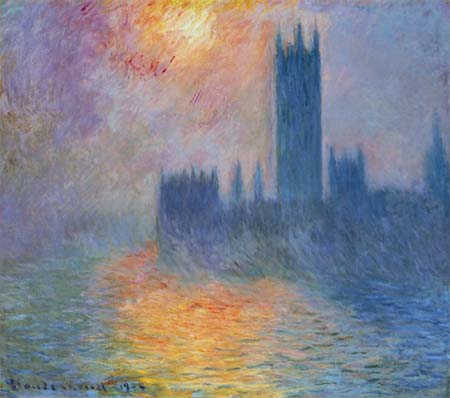
In this painting, The Houses of Parliament by Claude Monet, we see the silhouettes of the houses of Parliament with almost entirely blurred lines and no sharp images. The setting is sunset and the two things that stand out the most is the tallest tower of Parliament and the sun. There are no color blocks, all colors blend in with each other and it is not easy to pick out any particular detail. The colors involve mostly blues, some oranges with some red and variations on those colors due to them blending out into one of the other colors. It simply shows us a blurred image of the houses of Parliament at sunset.
I believe it would be interesting to analyze this painting from a Formalist perspective, considering we could look at the minimum of what Monet offers to us here. The way he paints, you often want to look beyond what is simply painted to what the image symbolizes, but in using Formalism we'd have to think simply about what is there not what we think is intended in inspiration. So the focus here is the silhouette of Parliament and the sun along with a bluish background. I suppose we can focus on the choice of lighting, since art all tends to have lighting coming from somewhere, even if the source is not easily identifiable. The source of light is the sun here, and it is the only source of light almost directly above the center of the image. Monet has chosen to contrast his colors and he has chosen to blend them and make them complimentary. Artists often choose one or the other. He chose landscape rather than portrait, since that allows him to focus less on detail and more on the broader picture. Because of this and because he chose to blur the entire thing I think we're allowed to focus the three points I mentioned earlier only: the sun, Parliament, and the blue background. To me this says that this is all Monet wanted you to see, rather than for you to see the tiny details of the windows of the lines of the ground and so on.
Works Cited
McCrory, Jeremiah. "Claude Monet Prints on Demand"Art of Europe Web. 2 March 2011 http://www.artofeurope.com/
Wednesday, February 23, 2011
Do we really need all this stuff?
"Art as a Technique" by Shlkovsky is one of the most interesting reads I've come across in a while, particularly concerning the part of Tolstoy making the familiar unfamiliar. In some parts it almost makes me consider Marxist theory because of the idea that we as humans might simply own only the things we produce or inhabit. A laborer does not own the products of their labor because he or she is usually working for someone else, which might be the case of the person who tends to the horse but is not the actual owner of the horse in Tolstoy's story. It is possibly one of the few aspects of Marxism and of familiarizing/de-familiarizing that I find simultaneously depressing and inspiring.
It isn't possible, really, in such a capitalist country to resort to selling and buy things from the person who actually made them with their own hands because we all demand so much. If we resorted back to this style, we could not in fact own as much as we do. I could not own this laptop because if it existed at all it would probably cost too much. I could try to make it myself but that would mean most people would have to know how to make their own cell phones and their own refrigerators.
But all of that comes down to desire. Should we, as capitalists, work on not desiring so much? It's the disease that spreads throughout many layers of our society. We desire so much in so many different areas of our lives that many of us are never satisfied. At this rate, the only thing we're teaching future generations is that the more you gain, the happier you'll be, even if you never again pay attention to half the things you purchase. Certainly no one would be happy living off of only what is necessary, such as food and shelter, but do we need five televisions on a three bedroom apartment? Do we need that brand new iPod even though our one year-old iPod is functioning perfectly? It seems to me that when you begin to own too many things by some form of decree, like a paper stating your ownership, then you're going way too far off the mark to be healthy. My best example would be if you own a home you never inhabit. Why own a home you never go to, that is only inhabited by people who keep it clean but don't consider it their own homes either? Isn't that unhealthy for you, that you desired a new home so much you decided you couldn't just have one?
I think there's something to be said over trying to keep with what we actually produce at a practical level. I can't produce my television, but at least I can try to keep the count of what I won and did not produce relatively low. I think, in the end, this would make for a happier mentality.
Wednesday, February 16, 2011
Is the sublime universal or personal?
When discussing ideas on what counts as being sublime and what doesn't, I wonder on whether or not we should ever categorize anything as sublime depending on how many people see it this way. There have been many discussions in what constitutes sublimity and what doesn't, in our English class for example it was clear that some did not agree with others on what a sublime moment was because it's all dependent on taste, perception and position relating to the sublime subject. I feel that the sublime can quite honestly be down to someone that only one person feels is sublime.
Personally, there are many things I encounter in films and in books that I find to be sublime time and time again even though others may not feel the same thing. Then of course there are sublime moments in which millions agree with me on its sublimity. Does my own small sublime moment become any less valuable? I don't think so, although I'm sure many would argue that a sublime moment requires a majority opinion. However, I see the concept of the sublime as I see the concept of beauty, which is that it is in the eye of the beholder and nothing else.
Tuesday, February 8, 2011
Analysis 1: The Art of Persuasion
The above video works to illustrate Aristotle's ideas on rhetoric by showing us an example of a speaker who is persuasive because of reasons outside of his actual rhetoric (or at least along with his rhetoric). It comes down often to things such as establishing a credible identity. In Obama's case it can be many things, such as his youth, his attractiveness, and his race. As an excerpt from Aristotle's Book II says, "for it makes much difference in regard to persuasion (especially in deliberations but also in trials) that the speaker seem to be a certain kind of person and that his hearers suppose him to be disposed toward them in a certain way". Obama made much of the youth in this country feel as though he was inclined towards caring what their opinions are, since in the video he mentions the supposed apathy of youth.
It is also greatly about presentation, not simply the persuasiveness of the content alone. Content can be extremely persuasive, but it can be delivered horribly and thus not actually achieve its goal of persuading anyone. There is an importance in being charismatic and the loss of elections are often due to lack of charisma, and this is illustrated in the importance of good speeches and good orators in our political system. Barack Obama is a great example of how presentation works in terms of being persuasive, because many times before his specific wording and general ideas have been compared to that of politicians such as former president Bush. While Bush and Obama shared the same ideas in some cases and even at times the same phrases or terms, many responded more positively to Obama because of the way in which he appealed to them. His physical features were important in that he was youthful and handsome, but it also mattered that he had a knack for public speaking, and at times it simply mattered that his voice was more appealing to people than that of Bush’s.
There is also the importance of the audience’s emotions. You can also look to politics here in that many times the audience, the United States for example, is inclined to a certain political party simply because they have lost their faith in the way of the old party. This is temporary, however, and stems from a feeling of disappointment in that the current party did not deliver what they promised. Politicians often use this to their advantage, knowing that the American people are tired of specific things, such as financial deficits and wars.
Credibility of character is also important here in that it is often valuable in persuading people of criminal cases for example by establishing some form of a personality for the people involved by either demonizing someone or making them look like victims, even if they were absolutely guilty of the crime, the jury and/or judge might still rule in favor of them deciding that it’s possible the crime was truly not their fault because something else might have been at play that affected them in some way that was out of their control, since their character implies that normally they would not have committed such a crime at all. Some might want to claim this is sneaky, but the truth is that it works on the best of us.
"Barack Obama Presidential Victory Speech pt 1/2 " 04 November 2008. YouTube. 6 February 2011
http://www.youtube.com/watch?v=xrKFYDbqUC4&feature=related
Wednesday, February 2, 2011
On the Gorgias Helen
I wonder how well Gorgias' defense of Helen was received at the time of him writing this considering how silly I find it to be now. I'm certainly not one to place blame on Helen when thinking of this story, the story of Helen of Troy, but his defense of "Well if it's the gods' will!" doesn't really hold well. If you kept that idea around then no one's behavior would ever be excusable or inexcusable because they'd all be pawns of the gods.
I'd rather agree with the idea that a good speech may have convinced her of leaving her home. Gorgias mentions the possibility of her running away for love, and how often do we know of stories in which a man or a woman (usually a woman) is persuaded by some well-prepared speech of deep love and admiration? Many argue that this is what happened with Juliet in the case of her and Romeo's tragedy. His speech of complete adoration convinced her to follow through with a series of events that eventually led to both their deaths. As Gorgias puts it, "speech is a powerful master and achieves the most divine feats with the smallest and least evident body" (39). I don't agree with the way that he follows his argument in saying that Helen being compelled by a speech is just about the same as forcing her to follow along. One can be manipulated, but one cannot be outright controlled. Was she manipulated? Possibly, but part of the blame in this argument should then be laid on her for not keeping her senses about her. Many people learn to push against persuasion in their lives, many stories in fact illustrate heroes pushing against persuasion from the gods themselves, so why should Helen get a free pass if someone was particularly convincing? Not that she's the most to blame here, because the other person, her persuader, would be the greater villain here for attempting in the first place.
My point here is simply that I don't think a speech, however great the speech, can be used to blame the speaker for the actions of those persuaded. I think a speech is incredibly strong and is capable of convincing people to do things, but I think it only plays one role in manipulation along with several other factors and I believe those factors should always be taken into consideration.
Gorgias. "Encomium of Helen". ed. Leitch, Vincent B. The Norton Anthology of Theory and Criticism. 2nd ed. New York: W. W. Norton &, 2010. Print.
Subscribe to:
Posts (Atom)